
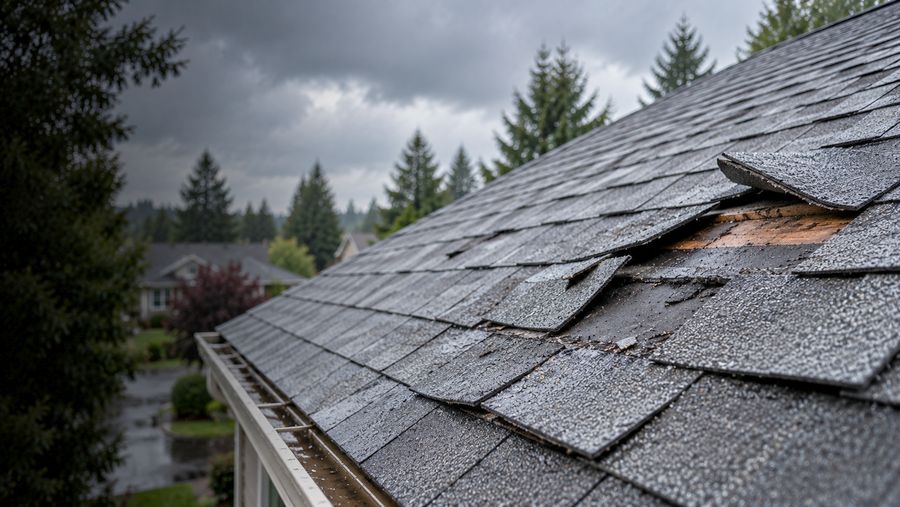
Why not just wait for summer?
Because the roof doesn't wait. A roof that's worn out or already leaking takes on more water with every storm from October to May, and that water goes into the decking, the insulation and the drywall. By the time the dry season arrives, the repair is bigger than it was. Summer is also when every roofing crew in the valley is booked solid, which is the other reason people end up waiting into fall.
If the roof is sound and you're replacing it on schedule, spring or summer is the easy call. If it's failing, the right time is soon, and the weather is a scheduling problem, not a reason to put it off.
What rain changes about the job
Two things. First, shingles can't be installed over wet decking. If the plywood is wet, it has to dry before anything goes on top of it. Second, the tear-off has to be planned around the forecast. On a dry summer day a crew can strip a whole roof and start laying shingles. In the rainy months the job is broken into sections: tear off what can be dried in and covered before the weather turns, then move to the next section on the next dry window.
That's why a winter replacement can take more calendar days than a summer one, even if the hours of work are the same.
How a roof stays dry mid-job
Once the old shingles are off a section, the decking gets a layer of underlayment as soon as it's clear and dry. The underlayment is what keeps the house dry between steps, and it's rated to stand in for the roof for a while. The rest gets covered with tarps, weighted and fastened so wind can't lift them. Nothing is left open overnight.
If you're getting estimates for a fall or winter job, this is the question to ask: what happens if it starts raining at two in the afternoon with half the roof off? A crew that does this every year will have a plain answer.
What cold changes
Asphalt shingles have a strip of sealant on the back. In warm weather the sun softens it and it bonds each shingle to the one below, which is what keeps wind from getting under the edges. Manufacturers give a minimum temperature for that to happen on its own. Below it, the strips don't bond until a warm day comes along, and that can mean weeks of shingles sitting loose.
The fix is old and simple: hand-sealing. The installer puts a dab of roofing sealant under each shingle as it goes down. It takes longer and it's the kind of step a rushed crew skips, so ask about it. Cold shingles are also stiffer and crack more easily if they're bent, so the crew works more carefully at the ridge and in the valleys.
What to expect on the calendar
Nobody can promise a dry week in November. What a good roofer can promise is a plan: the job starts on a day with a dry window, the crew tears off only what it can dry in and cover, and the schedule flexes around the forecast. You might see the crew for two days, then nothing for three while it pours, then two more days. That's the job working as intended, not a problem.
Ask for the plan in writing along with the scope and price. Here's what a replacement includes, and what changes the price.
Leaks don't wait either
Most of what's above is about a full replacement. Repairs are simpler: a failed vent boot, a piece of flashing, a few shingles taken by wind can be fixed in a dry window that lasts a few hours. In steady rain, the first job is usually a temporary fix that stops the water, and the permanent repair follows when the roof is dry. Here's what to do in the first hour of a leak.
Common questions
Can shingles be installed in the rain?
No. The decking has to be dry, and the shingles have to go on dry. Crews work in dry windows, even short ones, and cover everything before the rain returns.
How cold is too cold to roof?
Shingle manufacturers set a minimum temperature for the sealant strip to bond on its own. Below that, roofs still get installed, but the shingles are hand-sealed. Ask any roofer working in winter whether they hand-seal.
Will my house be open to the weather during the job?
It shouldn't be. Once a section is stripped it gets underlayment right away, and the rest is tarped and fastened. Nothing is left exposed overnight.
Is a winter roof replacement cheaper?
Sometimes roofers have more open dates in winter, but we can't speak for anyone's prices, including our own without seeing the roof. The scope of the work is the same in any season.
Does the new roof come with a different warranty if it's installed in winter?
The manufacturer's warranty on the shingles doesn't change with the season, as long as the installation follows their instructions, which is where hand-sealing in cold weather comes in. Ask what the installer's own workmanship warranty covers and get it in writing.
Tell us what you're seeing.
Call, text, or send a request. We'll talk it through and set up a time to look at the roof.
Thinking about a new roof before summer? What a roof replacement includes, in any season.
Keep reading: Repair or replace? Signs your roof is wearing out · Roof leaking in the rain? What to do in the first hour