
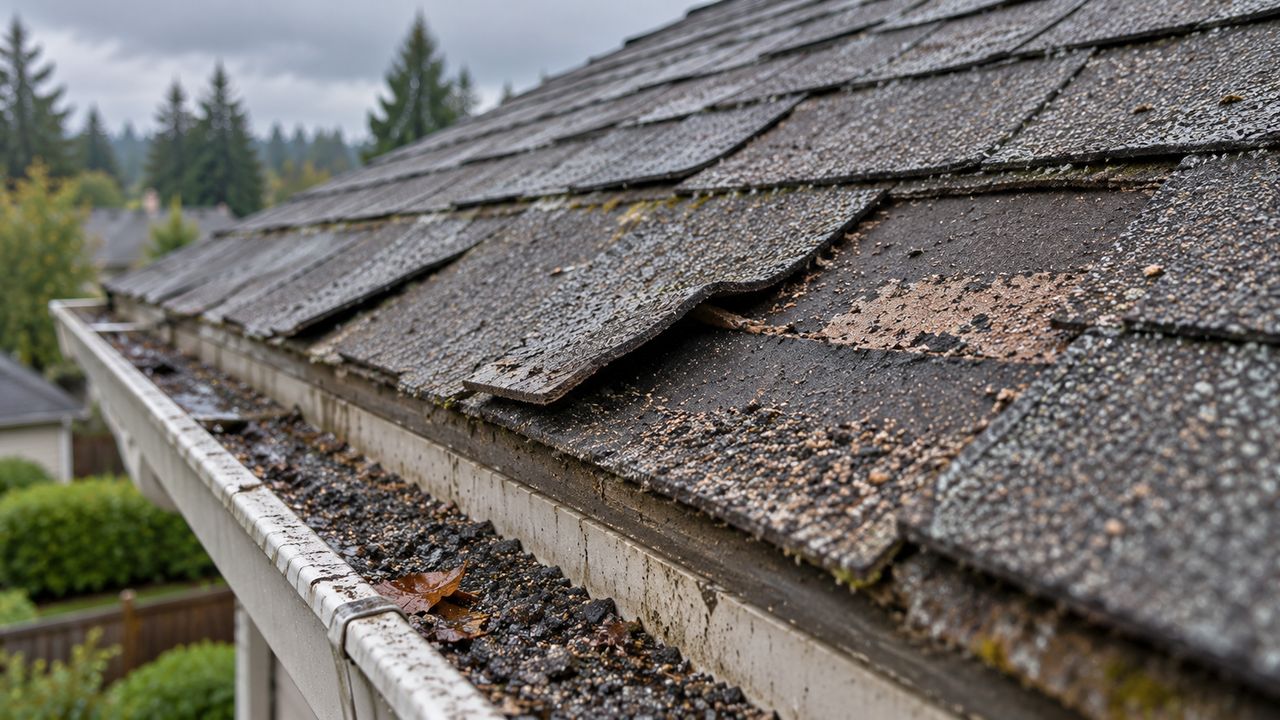
What wears a roof out in Oregon
It isn't one big storm. It's years of rain followed by summer sun. The oils in asphalt shingles dry out, the shingles get brittle, and the protective grit on top washes into the gutters. Shade and moss speed it up: moss grows under shingle edges, lifts them, and holds water against the roof long after the rain stops.
That's why roofs here often age faster than the number on the package, and why two houses on the same street, built the same year, can have roofs in very different shape. The one under the fir trees is usually the one in trouble.
The signs you can see from the ground
- Curling or lifted corners. Shingles that no longer lie flat have lost their flexibility, and wind gets under them.
- Bald patches. Dark, smooth spots where the grit is gone. The grit is what protects the asphalt from the sun.
- Grit in the gutters. A little at the downspout is normal on a new roof. A steady supply on an old one means the shingles are shedding.
- Moss that keeps coming back. Especially when the shingles stay lifted after it's cleaned off.
- Cracked or missing shingles. A few after a storm is a repair. New ones every winter is a pattern.
- A wavy or sagging roofline. This one matters most. It can mean the wood underneath has been wet for a long time.
The signs you can see from the attic
If you can get into the attic safely, take a flashlight up on a dry day and again after a hard rain. Look for:
- Dark stains or trails on the underside of the roof boards
- Damp or matted insulation
- Daylight showing where it shouldn't
- A musty smell that wasn't there before
Leaks in more than one place are the clearest sign of all. One leak is a repair. Leaks in three rooms are a roof telling you it's done.
When a repair makes sense
If the problem is in one place, like failed flashing, a split vent boot or a few shingles taken by wind, and the rest of the roof still lies flat and holds its grit, fix the problem. There's no reason to replace a sound roof because of one bad detail. A good roofer will tell you that, even though the repair is the smaller job.
When it stops making sense
When the shingles are worn out everywhere, a patch just moves the leak. You pay for a repair this winter and another next winter, and you still own an old roof. At that point the money is better spent once.
Age matters here for a second reason. Some insurance companies look harder at roofs once they reach about twenty years. If your insurer has asked about the age or condition of your roof, that's worth bringing up when someone comes out to look at it.
You can't settle it from the driveway
Some of this shows from the ground, but the deciding details don't: how brittle the shingles are, the state of the flashing, whether the wood underneath is soft. That takes someone on the roof. Ask whoever looks at it to show you photos of what they found.
Questions worth asking any roofer
- What's your CCB number? (In Oregon you can look it up on the state's license search in a minute.)
- Will I get the scope in writing, with what's included and what isn't?
- What happens if you find soft decking once the old roof is off, and how is that priced?
- What's covered by the shingle manufacturer's warranty, and what's covered by your own workmanship warranty? They aren't the same thing.
- Who will be doing the work?
For what a full replacement involves, see our roof replacement page.
Common questions
How long should a roof last in Oregon?
It depends on the shingle, the installation, how much shade and moss the roof gets, and how it has been maintained. Many asphalt roofs here need attention sooner than the label suggests, which is why the condition of the roof matters more than its birthday.
Can I put new shingles over the old ones?
Codes sometimes allow a second layer over the first. We don't recommend it: the old shingles hide the decking, add weight, and the new roof won't lie as flat or last as long. When a roof is worn out, it comes off.
Can I replace just one side of the roof?
Sometimes, if one slope has taken far more weather or shade than the other. The new side won't match the old one in color, and the old side is still old. A roofer can tell you whether it buys you enough time to be worth it.
Is it better to replace the roof before selling the house?
A worn roof will come up in the buyer's inspection either way. Replacing it first removes the objection. Leaving it usually means negotiating the price down or offering a credit. Your real estate agent will know which works better in your market.
What time of year is best for a new roof?
Dry weather makes the job simpler, which is why summer and early fall book up. Roofs get replaced year round in Oregon, though, by working around the rain and keeping the house covered between steps.
Tell us what you're seeing.
Call, text, or send a request. We'll talk it through and set up a time to look at the roof.
When it's time: what a roof replacement includes, and what changes the price.
Keep reading: Moss on your roof in Oregon: what it does and what to do about it · Water stain on the ceiling? Here's where roof leaks start